
Welcome to the sticky, wonderful world of resin crafting.
If you are reading this, you have likely stared at an online shopping cart filled with bottles labeled "A" and "B," or perhaps small black bottles promising instant cures, and thought: "Which one do I actually need?"
You are not alone. The most common stumbling block for beginners in the resin art world is understanding the fundamental difference between the two main players: Epoxy Resin and UV Resin.
While they both dry into a hard, glossy, plastic-like finish, how they get there—and what they are capable of doing—are vastly different. Choosing the wrong one for your specific project can lead to sticky messes, wasted expensive materials, and heartbreak.
In this ultimate showdown, we are stripping away the chemistry jargon to give you a clear, practical comparison so you can pick the perfect medium for your next masterpiece.
Contender #1: Epoxy Resin (The Slow & Steady Giant)
If resin were baking, Epoxy is the slow-cooked Sunday roast.
What It Is:
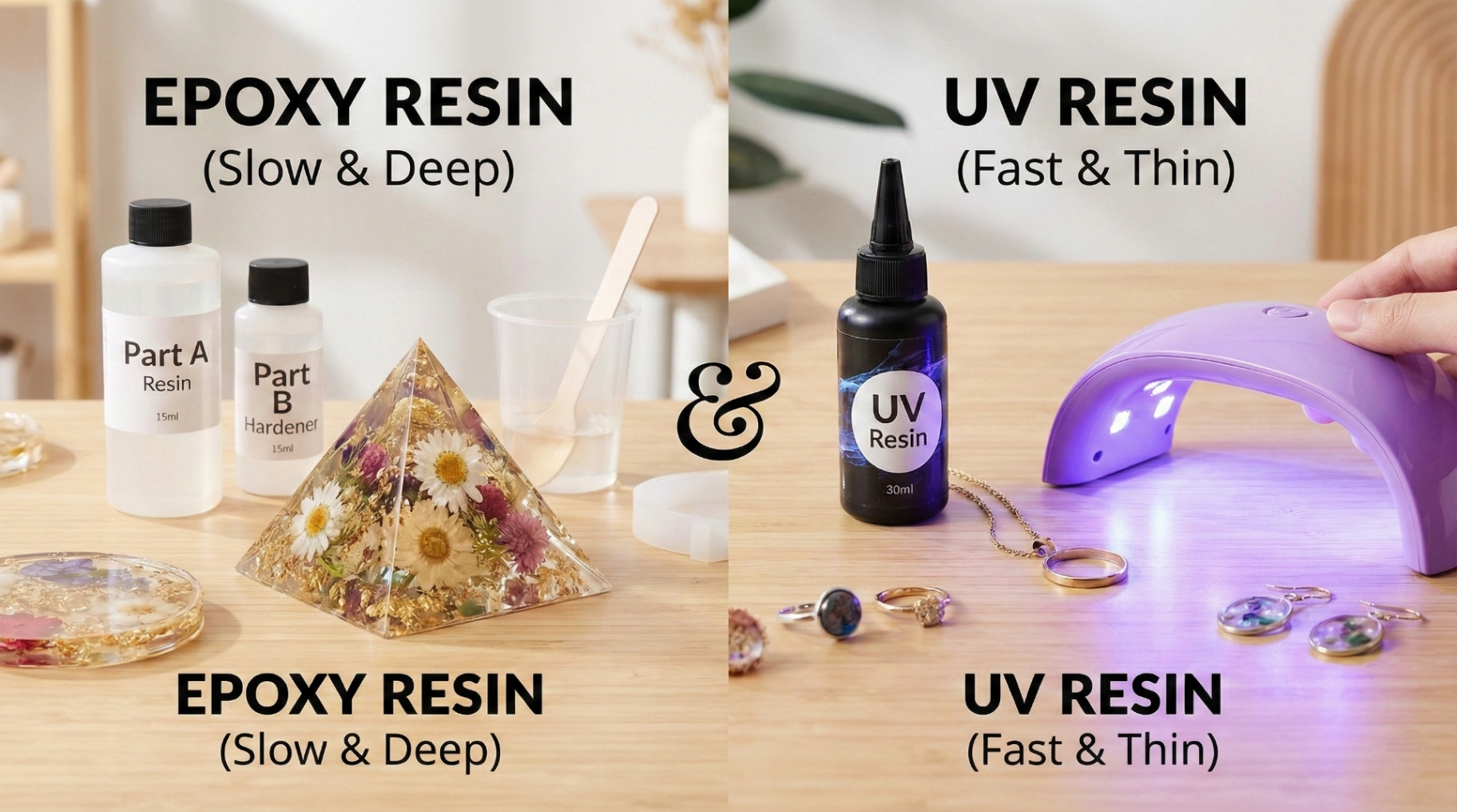
Epoxy resin is a two-part system. You purchase it as two separate bottles: a Resin (Part A) and a Hardener (Part B). On their own, they will remain liquid forever. The magic happens when you mix them together.
How It Works:
Mixing parts A and B starts a chemical reaction that generates heat. This reaction slowly turns the liquid mixture into a solid. This process is called "curing."
Key Characteristics of Epoxy:
- Mixing is Crucial: You must measure the two parts exactly according to the manufacturer's ratio (e.g., 1:1 or 2:1) and mix them thoroughly. If you are off by even a little, your project may remain sticky forever.
- Patience Required: Epoxy takes time to cure. Depending on the specific brand and room temperature, it can take anywhere from 12 to 72 hours to become fully rock-hard.
- Deep Pours: Epoxy is designed for volume. If you want to cast deep molds, create river tables, or cover large surface areas, epoxy is your only choice.
Contender #2: UV Resin (The Instant Gratification Speedster)
If Epoxy is the slow roast, UV Resin is the microwave dinner—fast, convenient, but best in small portions.
What It Is:
UV resin is a single-part system. It comes ready to use straight out of the bottle. There is no mixing, no measuring, and no rush against a pot life clock.
How It Works:
UV resin stays liquid until it is exposed to ultraviolet light. You can work with it for hours indoors away from windows. Once you are happy with your design, you hit it with a UV lamp (or take it out in bright sunlight), and it cures almost instantly.
Key Characteristics of UV Resin:
- Instant Cure: Under a proper UV lamp, thin layers can cure in as little as 60–120 seconds.
- Thin Layers Only: This is vital. UV light must be able to penetrate all the way through the resin to cure it. If you pour it too thick, or add opaque pigments that block light, the middle will remain liquid while the outside hardens.
- Higher Cost Per Ounce: Generally, UV resin is significantly more expensive by volume than epoxy.
The Head-to-Head Comparison
Let’s break down the deciding factors for your projects.
1. Curing Time
- Epoxy: Hours to days. You need a dedicated, dust-free space where the project can sit undisturbed for at least 24 hours.
- UV Resin: Minutes. You can finish a project in one sitting.
- Winner: UV Resin for speed; Epoxy for patience.
2. Project Size and Depth
- Epoxy: The king of volume. Essential for deep silicone molds, pyramids, paperweights, trays, and large coating jobs.
- UV Resin: Strictly for small, thin items. Think jewelry bezels, thin pendants, coating small stickers, or doming tiny stud earrings. Do not try to cast a paperweight with UV resin.
- Winner: Epoxy Resin.
3. Ease of Use (The "Fuss" Factor)
- Epoxy: High fuss. Requires precise measuring cups, scales, thorough mixing to avoid the "dreaded sticky spots," and dealing with bubbles that rise slowly over time.
- UV Resin: Low fuss. Squeeze straight from the bottle. Bubbles are easier to pop instantly with a heat gun before curing.
- Winner: UV Resin.
4. Equipment Needed
- Epoxy: Mixing cups, stir sticks, gloves, a level surface, and patience.
- UV Resin: A UV lamp (essential for consistent indoor results). Sunlight works, but is unreliable.
- Winner: Tie (depending on if you'd rather buy mixing cups or a lamp).
Which Should You Choose?
Choose Epoxy Resin If:
- You are making large items like coasters, trays, or river tables.
- You are using deep silicone molds (anything deeper than a few millimeters).
- You need the most cost-effective option for large volumes.
- You have a dedicated space to let things cure overnight.
Choose UV Resin If:
- You are making small jewelry (rings, earrings, bezels).
- You are impatient and want results in minutes.
- You want to add quick domed layers over vinyl stickers or photos.
- You need to do quick repairs on existing resin pieces.
- You hate measuring and mixing.
Final Verdict
There is no single "best" resin. They are different tools for different jobs.
Many serious crafters end up keeping both in their arsenal. They use epoxy for the heavy lifting of casting the main piece, and then use UV resin for quick top coats, attaching bails to jewelery, or fixing small imperfections instantly.
Look at the project you want to create right now. Is it deep and large? Go Epoxy. Is it tiny and thin? Go UV. Choose wisely, and happy crafting!